How the Bristol Chinese RnB Club got its strange name. The Bristol club started out as The Chinese Jazz Club and evolved as “Uncle Bonny’ saw music tastes shifting from Jazz to Blues then known as Rhythm and Blues or simply RnB.
UNCLE BONNY
The Bristol club had its routes in the Swindon Oriental Jazz Club which was part of the various jazz clubs put together by Bonaventura Guiseppe Michaelangelo Dominic Giovanno Manzi, the self-styled ‘Uncle Bonny’, (or ‘Uncal’, which the newspapers reported that he claimed to be the ‘Chinese Way’ and back then you could get away with such a statement as nobody was likely to have the means or inclination to check such a statement.),
Both of his parents were born in England and Bonny was born in Islington, London, in 1930 of Italian descent parents, which must have been interesting during WW2 as the Italians fascist joined with Hitler’s fascists and became enemies of the UK.
The family moved to Chertsey, to run a farm, and also where his father also trained horses for show jumping. The father could play a number of string instruments, and taught ‘Bonny’ to play banjo and mandolin. This led to Bonny forming a group of musical entertainers and impressionists – called ‘Bonny’s Bandwagon’, which gigged at places like old people’s homes, next he formed a skiffle group (skiffle being a brief music rage ), and then a jazz band that played at the Riverside Hotel, Chertsey.
Bonny saw a greater potential as a promoter rather than a player of jazz, and he began searching for venues where he could put on what would now be called ‘pop up’ jazz nights. To attract publicity he would drive around in an ancient London taxicab, which art students had painted images of musical instruments.
One of Bonny Manzi’s jazz clubs was in the Aquarium at Brighton, which was where the ‘Chinese’ part of his club names come into being. Offered the upstairs room at the Aquarium, he didn’t not like the lighting. Bonny had an office in the Cy Laurie jazz club opposite the Windmill Theatre in Soho, London. One day, when walking through nearby Berwick Street Market, Bonny noticed a Chinese shop stocked with Chinese newspapers, records, joss sticks, and lanterns. He bought some lanterns, to disguise the light fitments in Brighton, and he also bought (half a pound) potatoes from Berwick Street Market, which, he quartered, to provide the bases for joss sticks with which he would bring what he felt was a oriental atmosphere to the room. On an old gramophone, he played the one Chinese record he had bought in the same market. He guessed that calling his club the Brighton ‘Chinese’ Jazz Club would make his club stand out, it must of worked as he stuck with the name as he added more venues.
Not only did the inclusion of ‘Chinese’ garner publicity, it even brought Chinese people to visit. On one evening, seven smartly dressed Chinese men came to one of Bonny’s clubs. They were members of a trade mission to London, and asked enquiring where could find some Chinese culture, for some reason they were directed to the ‘Chinese’ jazz club. Apparently they spent the entire evening thoroughly enjoying what their Chairman Mao Zedong would describe decadent western music. Bonny liked to suggest this sowed a subversive seed on their return home to China.
When local newspapers speculated on why their town had suddenly acquired a ‘Chinese’, ‘Oriental’ or ‘San Pan’ jazz club, and debated the title. The Swindon press claimed that Bonny justified the name by referring to an American dictionary that described ‘oriental’ as being synonymous with ‘magnificent’, Bonny sported a straw boater at gigs, and kept up references that he would never get away with now. He annotated the club’s publicity hand-outs and prefaced his interval notices of forthcoming attractions at the club with the words: ‘Chop Chop, Velly Good’,
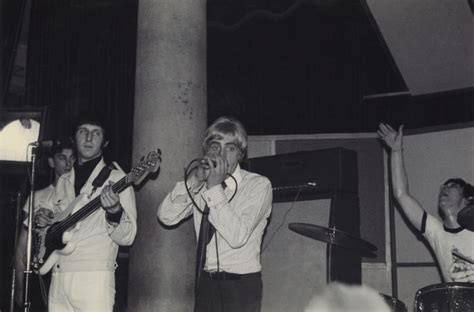
The “Chinese RnB club” at the Bristol Corn Exchange was a popular night for the Mods of that time. Scooters would roar up and down adorned with spotlights, mirrors, and whippy aerials that often sported a foxtail. Boys in M51 original Parkas, low waisted colourful trousers, two tone shoes, op art shirts and French chop hair. Girls with short skirts, white tights, panstick white make up and bobbed hair, this was the place to see and be seen music night in the mid-1960s. Sensibly no leather jacketed ‘Rocker’ or ‘Grease’ ventured near
• The club started out being known as the “Chinese Jazz Club,” but it soon became clear to Bonny that despite many ‘jazzer’ punters turning their noses up at the new British blues bands this was where the future lay and soon he hosted nights that primarily featured Rhythm and Blues (R&B) music, the and R’n’B” usurped the jazz part part of its name. The “Chinese” theme was evident in the Brighton club’s décor, which reportedly included Chinese lanterns and burning joss sticks.
• Location and Time: It was located in the Bristol Corn Exchange (which is now part of St Nicholas Market) on Corn Street, Bristol, during the mid-to-late 1960s. The club night was typically held on Tuesday and Saturday evenings.
• Musical Legacy: The Corn Exchange was a significant music venue in the 1960s, and Uncle Bonny’s club was a hub for the thriving R&B scene, acting as a stage for both local and up-and-coming “underground” artists. Notable acts who played the venue during this period included:
• The Rolling Stones (who apparently performed there on their very first UK tour in December 1963, though this pre-dates the specific “Uncle Bonny’s” nights by a short time.
- The Who, Cream, Pink Floyd (1967 with Syd Barrett and their early psychedelic/bluesy stuff), Small Faces, The Birds (Ronnie Wood joined with Jeff Beck, The Faces, then The Rolling Stones. Pete McDaniels played drums in The Birds and could solo for up to 20 minutes), The Byrds (the famous American act). The Uglys, Geno Washington and The Ram Jam Band, Jimmy James and The Vagabonds, Dave Berry (The Crying Game 1964 ) – watched him electrocute himself with a borrowed microphone touching a mic stand, a bang and flash and he was literally flung horizontally across the stage and taken to Bristol hospital for the night, the band played stayed playing The Crying Game with its wah wah effect as the bouncers came on stage, picked up the prone Dave Berry who was like a plank of wood on until the end of the number!).
- Jimi Hendrix. Nobody took any notice as he wandered in carrying his guitar case followed by a girl friend, and quietly went behind the backstage curtains. As per usual there were about four rows of metal frame canvas seats and the rest of the floor available for dancing. Needless to say he and his band were fantastic and he duly played the solo on Hey Joe with his teeth. A few weeks later he packed the Bristol Locarno ballroom. By then the word was well and truely out not only as a great act but as an act for women to scream at.
- The Locarno where I saw Andy Fairweather-Low in Amen Corner, The Troggs. Lee Dorsey, (1966), Stevie Wonder who had become famous with the hit ‘Uptight.”
John Mayall
- John Mayall Blues Breakers (including John Mayall’s Bluesbreakers was famously a revolving door for some of the most influential musicians in British rock and blues. The 1960s lineup, in particular, reads like a “who’s who” of future rock legends.
Here are the some of the significant musicians who played in John Mayall’s Bluesbreakers during the 1960s, broken down by instrument:
🎸 Lead Guitarists (The Famous Three)
Mayall earned a reputation as a great talent scout, particularly for guitarists. The three major guitarists of the 1960s all went on to massive fame:
• Eric Clapton (1965–1966): After leaving The Yardbirds, he defined the sound of the band on the influential album Blues Breakers with Eric Clapton (the “Beano” album). He left to form Cream.
• Peter Green (1966–1967): Green initially suffered as Clapton’s replacement, somehow he was viewed as a usurper. He played on the album A Hard Road. He is revered for his sensitive tone and immense talent, and he soon left to form Fleetwood Mac (taking the rhythm section with him).
- Mick Taylor (1967–1969): Joined at the young age of 18, he played on albums like Crusade and Bare Wires. He was later famously recruited to replace Brian Jones in The Rolling Stones. The Stones lifestyle proved too much for Taylor . Taylor did mainly overdubs on Live With Me and Country Honk on the Let It Bleed album in 1969. Came into his own on Sticky Fingers (1971), Exile On Main Street (1972), Goats Head Soup (1973), Its Only Rock ‘n Roll (1974) and appears on the live album Get Yer Ya-Yas Out (1970)
🎸 Bassists
• John McVie (1963–1967): The band’s founding bassist, he was Mayall’s longest-serving rhythm section member during this period. He later became the “Mac” in Fleetwood Mac.
• Jack Bruce (1965): Briefly played with the band before leaving to co-found Cream with Eric Clapton.
• Tony Reeves (1968): Played on the Bare Wires album before leaving to co-found the progressive jazz-rock band Colosseum.
• Andy Fraser (Late 1960s): Though a brief tenure, he would go on to be a founding member and primary songwriter for Free.
🥁 Drummers
• Hughie Flint (1964–1966): Played on both John Mayall Plays John Mayall and the Blues Breakers with Eric Clapton album.
• Aynsley Dunbar (1966–1967): Played on A Hard Road and later became a prominent session drummer and member of bands like The Jeff Beck Group and Journey.
• Mick Fleetwood (1967): Had a very short tenure before joining Peter Green and John McVie to form Fleetwood Mac.
• Keef Hartley (1967–1969): Played on Crusade and Bare Wires before forming his own successful band, The Keef Hartley Band.
🎷 Other Key Members
- Dick Heckstall-Smith (1968–1969): Ex Graham Bond Organisation with Jack Bruce) Saxophone player (could play 2 saxophones at once) who also left to co-found Colosseum with Tony Reeves.
• Chris Mercer (1966–1968): Saxophone player.
• Jon Mark (1969): Guitarist who played on the acoustic, drummer-less album The Turning Point before forming the duo Mark-Almond.
John Mayall is often called the “Godfather of British Blues” for his role in providing a platform and a rigorous apprenticeship for a whole generation of British rock talent.
• American blues legends like John Lee Hooker and Sonny Boy Williamson. Bo’Diddley
- Local bands like the Strange Fruits did well- their name inspired by the 1939 Billie Holiday recording lyrics and music written by Jewish- American teacher and activist Abel Meeropol, who published under the pseudonym of Lewis Allen. He wrote the song after seeing photographs of the lynching of two Black teenagers in Marion, Indiana (www.Britannica.com) Nina Simone did a great version in 1965)
- The Graham Bond Organisation, The Vagabonds, and The Steam Packet (featuring John Baldry, Rod Stewart, and Julie Driscoll) are also documented to have played the Chinese R&B Jazz Club in 1965.
• Closure: The Corn Exchange ceased operating as a major music venue by the end of the 1960s, and the space was later transformed into the indoor market that exists today (St Nicholas Market).
In summary, the “Chinese RnB club” was a key part of Bristol’s vibrant 1960s music scene, hosting legendary acts and contributing to the city’s reputation as a cradle for British R&B.
 Kevinshome